
The Golden Rule in online trading: Positive correlation

The Golden Rule in Online Trading

As you may or may not know gold is the world’s most traded precious metal. Gold (XAU) refers to the gold spot market price. Nowadays, gold is used vastly in the jewelry market and for investment purposes, it is regarded as a safe haven commodity. Gold was mostly extracted during post-war era and is sought after all over the world, typically bought for a premium over spot and sold at a discount to spot in physical exchanges.
The reason that gold is considered a safe haven, can be attributable to its intrinsic value. Meaning that it remains relatively stable during times of uncertainty and high volatility in the market and rarely experiences unpredictability.
For now, let us focus on the Australian dollar and how this currencies strength and value is dictated by the performance of its imports and exports.
Taking into consideration that the gold from Australia is essentially the ‘gold standard’ as it accounts for roughly 80% of gold in the market. If the price of gold increases, and Australia are world’s leading exporter of this commodity, the price of the Australian dollar is expected to increase also.
Positive correlation
One might assume, if you hear about this commodity in the news, you are likely to hear about positive correlation to the Australian Dollar. But why?
There are many ways gold is correlated with numerous currency pairs, such as USD, AUD and CHF.
First allow me to explain correlation. When analyzing two variables, you will be given either one of two outcomes. Positive or Negative Correlation.
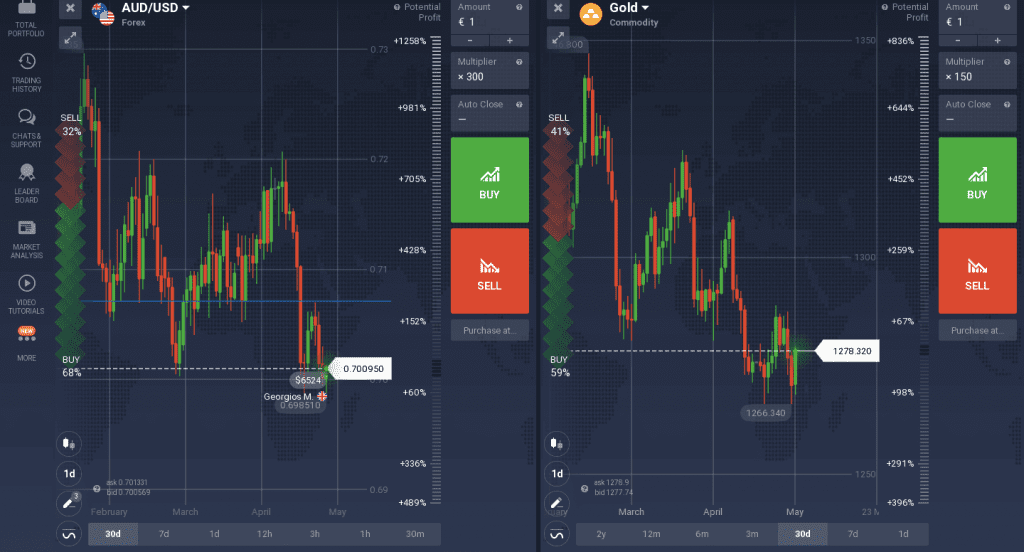
Positive correlation in action
Positive correlation simply put, is when two variables have a parallel relationship moving in the same direction. In this case, as AUD increases in price, so will the price of gold.
However, with Negative correlation, this is when two variable have opposing reactions and do not follow each others pattern. They in fact deviate from one another, for example, gold and USD are considered to have a Negative correlation as they move in opposite directions.
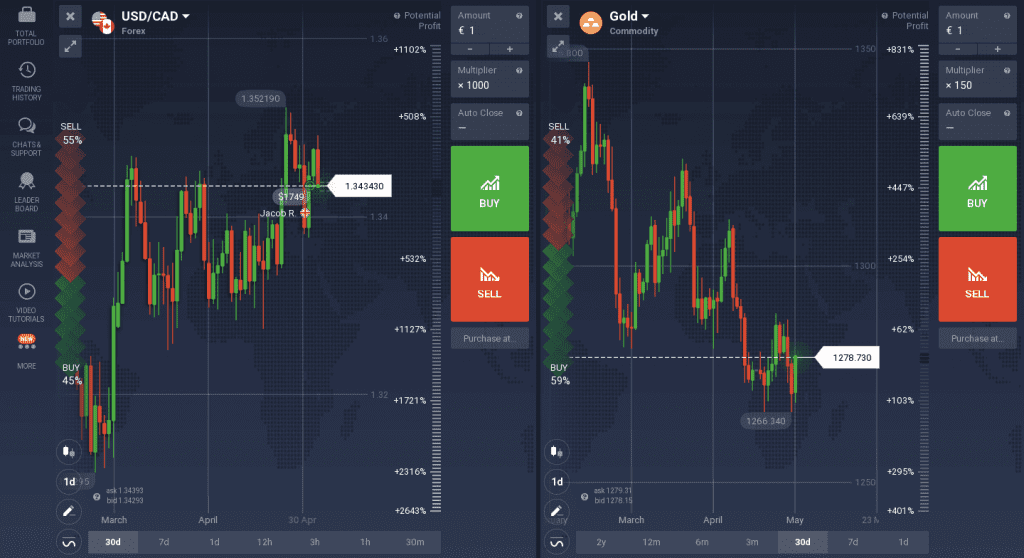
Negative correlation in action.
If you would like to discuss any of the topics mentioned in this article, please do not hesitate to leave a message, or perhaps contact support to set up a training session or to request more information.
Information regarding past performance is not a reliable indicator of future performance.
Try For Free


NOTE: This article is not an investment advice. Any references to historical price movements or levels is informational and based on external analysis and we do not warranty that any such movements or levels are likely to reoccur in the future.
In accordance with European Securities and Markets Authority’s (ESMA) requirements, binary and digital options trading is only available to clients categorized as professional clients.


GENERAL RISK WARNING

CFDs are complex instruments and come with a high risk of losing money rapidly due to leverage.
77% of retail investor accounts lose money when trading CFDs with this provider.
You should consider whether you understand how CFDs work and whether you can afford to take the high risk of losing your money.

Comments

Popular posts from this blog

8 Risk Management Tips from the World’s Top Traders

When it comes to trading, a lot of people believe that the most important skill you can get is  making more money , when in reality (according to more experienced traders) it is  not losing what you already have . After all, even Warren Buffett, the world’s third richest man and an investment icon, believes that your #1 rule as a trader is to never lose money. This article is the collection of 8 quotes by renowned investors that might  help you better understand the nature of financial risks and manage your losses. This knowledge is important as  it could help you stay in the game when everything seems to be against you  (because, as you know, you could lose all of your money and your trading would suddenly end). “I’m always thinking about losing money as opposed to making money. Don’t focus on making money, focus on protecting what you have.” — Paul Tudor Jones “The elements of good trading are: (1) cutting losses, (2) cutting losses, and (3) cuttin...

John Murphy’s Laws of Technical Trading

John Murphy is an icon of technical analysis and a talented book writer. This article is a collection of his recommendations to new traders. 1. Map the trend The trend is not always easy to spot. Sometimes you have to find it using various technical analysis tools. What may seem like a flat movement in the short run can turn out to be a trend in the long-run. Even if you trade on shorter time frames, it may be beneficial to  understand the general picture and act accordingly . This method can also help when getting rid of the price noise. What may seem like a flat market on shorter time frames can turn into a trend on longer ones 2. Draw the line As soon as you determine the trend direction,  mark the trend with (support/resistance line) a line or two (the so-called price corridor) . The line should connect the dots on the price chart. A downtrend is a series of lows that get lower as the time passes. An uptrend, on the contrary, is a collection of highs that get hig...

Learn to Understand Quotes Better

Have you ever been confused by the quotes that are used when you open and close the deals? If you ever wondered why the deal was opened above or below the line that you see on the chart, this article is for you. Let’s make it clear once and for all! Bid and Ask First of all, it is important to know about the basic Ask and Bid prices. Ask price is the price at which you buy the asset. Bid is the price at which the asset is sold.  Ask and Bid quotes are the quotes at which you open your CFD-type deals on the IQ Option platform.  The difference between Ask and Bid prices is called Spread. You may enable the visibility of Ask and Bid quotes in the settings menu and this is what it will look like: So how does it work? Let’s look at an example. Let’s say you open a deal on GBP\NZD, under the Forex tab. You make a prediction that the price will go up and open a <Long> position by clicking <Buy>: The deal is opened at the level of the current <Ask>...